
News
When Commitment Becomes Artistry
April 29, 2026
Last week, we explored the second movement of the Sinfonia journey: the moment when a student moves from belonging into responsibility. Through the voices of Noah, Grier, and Nate, we saw what it looks like when a young musician begins to take ownership of their playing, their section, and the shape of the ensemble itself. That growth is foundational, but it is not the end of the story.
This week, we turn to what comes next.
By the time a student reaches Philadelphia Sinfonia, the organization’s top ensemble, the music is harder, the standard is higher, and the student in that chair is not the same student who once walked nervously into a first audition. Something has changed. You can hear it.
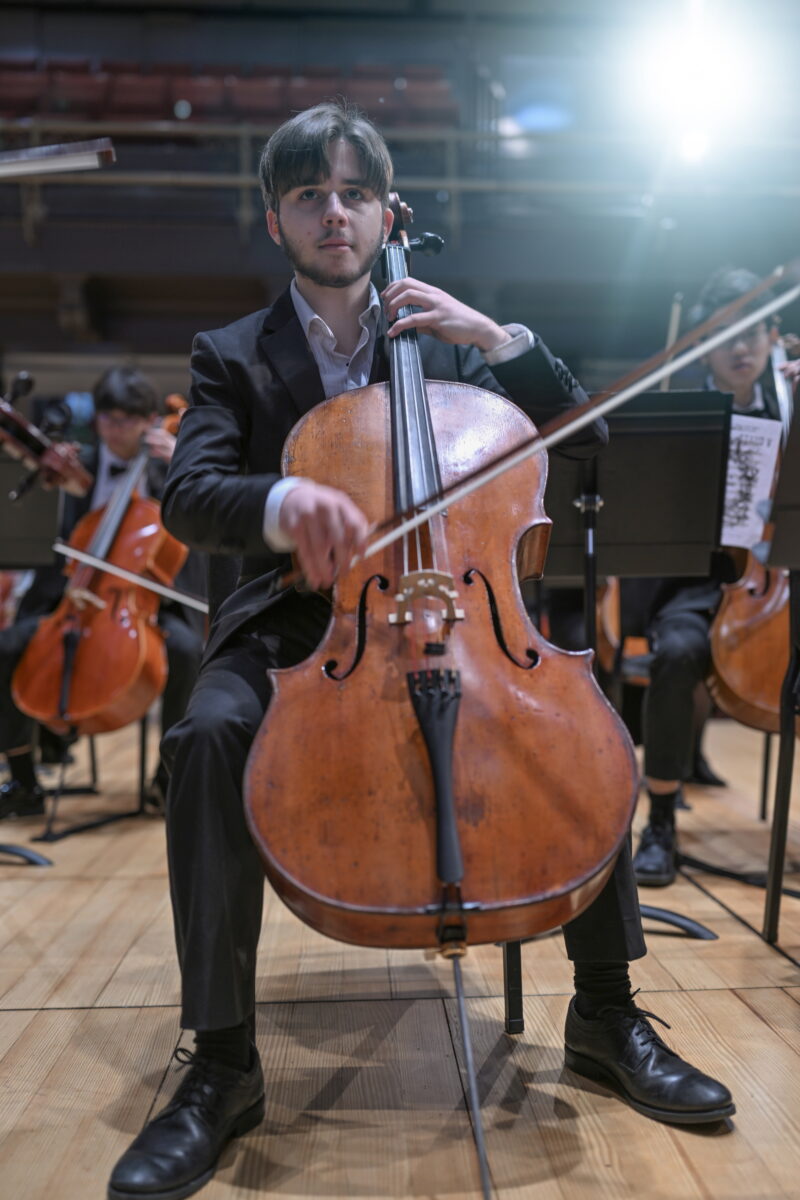
That change is not only technical. Students at this stage of their development have begun to speak about music in a different way. They are no longer focused on whether they can play the notes. They are focused on what the notes are for. Aldo Friedman, a cellist in his third year of PS, expressed that idea in a way most professional musicians would recognize immediately. As he described his own growth, he said, “I have learned to get in the way of the music as little as possible. It is not like ‘yes, my intonation has improved, my tone has improved,’ but when I am performing, that is not what I am showcasing. I am showcasing the music. Having good tone and good intonation and good technique helps you not get in the way of it.” That is not a sentence a teenager arrives at on their own. It is the product of years inside a particular kind of musical community, with particular kinds of teachers, playing particular kinds of music. It is the destination toward which every part of the Sinfonia journey has been quietly pointing.
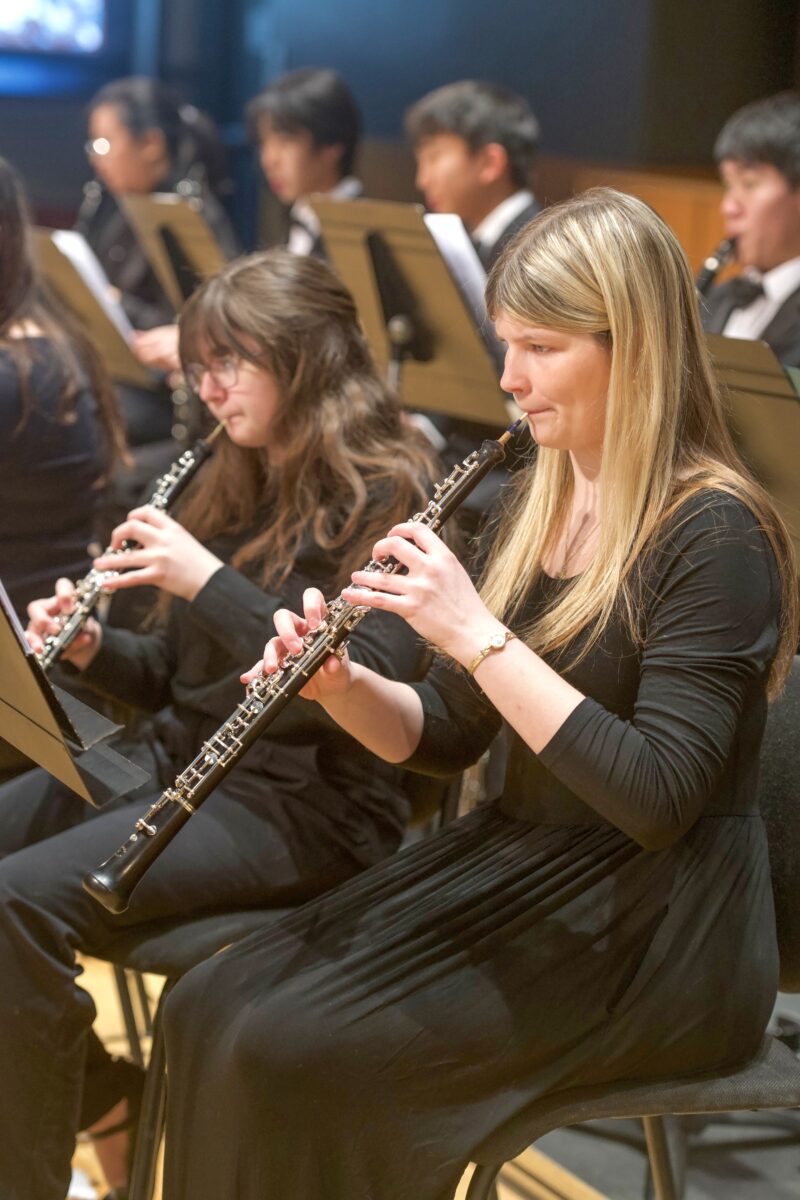
What makes that kind of artistry possible is not only practice. It is also the environment in which practice happens. Victoria Laabs, an oboist in her third year with Sinfonia, has played in a number of orchestras over the years, but she keeps coming back to one. As she put it, “I have been offered a lot of different orchestras, but I always come back to Sinfonia, because it creates a family here. When they give parts that are really hard, I feel like I can just play them, and even if I mess up, they will not be there to judge me. They will work with me until I get it.” Young musicians do not arrive at deep artistry in environments where they are afraid to fail. They arrive there in environments where the standards are high and the support is steady, where they are asked to stretch and are also given the room to stumble along the way.
That balance is something Aldo has noticed too. Reflecting on his experience in other youth orchestras before finding Sinfonia, he said, “It is so much more supportive, and frankly less cutthroat, than other youth orchestras. Which just helps you grow more, and gives the ensemble its own sound. And honestly, it sounds happier than an ensemble that gets yelled at by a conductor.” Fear can produce compliance, but it does not produce artistry. The students who reach the level of musicianship Aldo described do not arrive there by being intimidated. They arrive there by being given hard music, taken seriously as artists, and supported through the difficult work of learning to play it well.
Anna Knutson, a junior and violinist now in her fourth year with Sinfonia, named one of the things that first drew her in. “I like the repertoire choices a lot,” she said. “Not many youth orchestras get to play the original 1812 Overture. That is awesome.” A supportive environment does not mean a low bar. At Sinfonia, the repertoire is genuinely demanding, and students are expected to rise to meet it. Over time, they do.
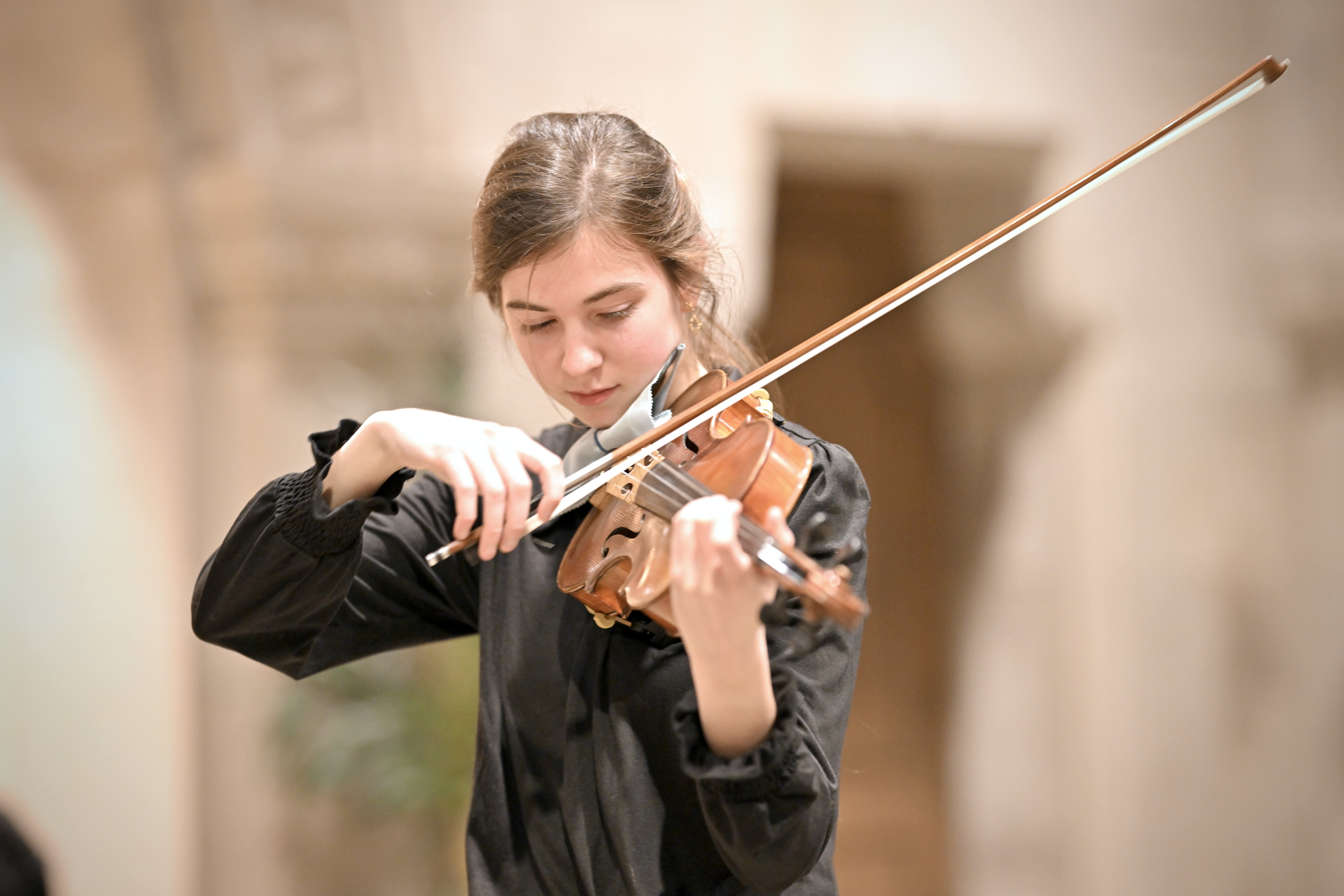
The growth itself can surprise even the students experiencing it. Three years ago, Victoria was a quieter musician. As she remembered it, “When I first started here, I was very shy. I played very quietly. I played in my stand. I was not given many solos, because I never played out, and I just kept to myself.” What followed was a transformation she did not see coming. “It was not linear. It was exponential. It was just from zero to one hundred within a year, where I changed as a person completely. I was able to sight-read music better than I ever have before, and I was also able to express my feelings through music better.” That is the arc of a young musician finding her voice, both in her playing and in herself.
For Victoria, that growth has opened doors she would never have imagined. This year, she played a side-by-side with the Philadelphia Orchestra, seated between two of its principal oboists. As she described the experience, “I learned to be confident when playing, because they were very confident. I will never get another opportunity to play with the Philadelphia Orchestra. That was honestly one of the best moments of my life.” In the fall, she will be a music major at the University of Delaware. Those kinds of opportunities and life directions are not the result of a single concert or a single year. They are the result of years of patient teaching and steady investment in the students who pass through these ensembles.
For Anna, all that accumulated growth has become something she can finally turn outward. When asked what it means to her to be performing at the level she has reached, she answered with striking clarity. “It means I am able to give more. When I have a gig, or I play for my family, or possibly going on professionally, I am able to really be a musician, and share the gift that I have been given here.” The student who began by simply trying to play the notes has become a young artist with something to offer. The gift she received is now a gift she can extend to others.
When Anna was asked what she would say to her younger self, right before that very first audition, she did not hesitate. “I would say it is worth it. It is worth all of the work. It is worth the struggle of coming into rehearsal not super prepared, freaking out because you need to practice. It is worth the practice. It is worth the struggle. It is worth messing up and doing better. It is worth it.” That is the whole story, told in five sentences by someone who has actually walked it. The auditions. The rehearsals. The hard repertoire. The years inside a room where it is safe to fail. The slow, mostly invisible work of becoming the kind of musician who can get out of the way of the music. On May 22, the students of Philadelphia Sinfonia will take the stage for their final performance of the season, and for several of our seniors, their last concert with Sinfonia. It is the culmination of everything this stage of the journey has been about.
This spring, Philadelphia Sinfonia is raising $7,500 to support the students, teaching, and ensemble experiences that make this kind of growth possible. If you would like to support Sinfonia’s students as they grow into the artists you have just read about, we invite you to make a gift in support of this work. And we hope you will join us for the Philadelphia Sinfonia concert on May 22 to hear what these students have built together.
With several concerts still ahead this season, there will be many opportunities to hear Sinfonia’s students in performance and to experience the results of their hard work firsthand. Each concert reflects a different stage in the journey, and we hope you will join us for these upcoming performances as the season moves toward its final bow.
We are also looking ahead to auditions for the coming season. For young musicians who are ready to be challenged with serious repertoire and supported through the slow work of becoming real artists, Sinfonia offers a place to grow. We encourage interested students and families to learn more about audition opportunities in the weeks ahead.
From first notes to final bow, Sinfonia is helping young musicians grow into more. This week, we are grateful to celebrate what that growth looks like in Philadelphia Sinfonia.